Why Do People Need Big Projects?

Here is the second story, a continuation from the previous one.
Why does a person need big projects??
By Yana Frank.
Another story told by Abdullah. This time he wanted to explain to me that one cannot spend one’s whole life occupied only with small things, whether it is a drawing made in an evening or a craft completed in an hour or a week. Everyone needs large projects: heavy, long-term ones that demand great strength and courage. Why?
On the path of development, a person passes through special states of spirit and overcomes spiritual stages.
By special states of spirit, the Sufis mean everything that takes hold of the seeker’s heart when he has no intentions of his own, that is, under the influence of pure love proceeding from the highest truth. Put more simply, these are states into which a person is plunged under the force of strong feelings arising from longing or in moments of illumination. Like the feelings that cause them, these special states of spirit appear and disappear in an instant, or else creep in slowly and recede, but they are always temporary in nature. Euphoria, happiness, sadness, helplessness, anger, excitement. These emotions inspire great deeds and give rise to the desire to create, but their appearance is not subject to the will; they come, change, and go away, and sooner or later, a person grows tired of them. Special states of spirit are nothing other than mirrors of fleeting moods. The duration of their existence is determined by an incomprehensible divine force. A creative person experiences rises and falls many times a day, but whatever he manages to do while soaring on the wings of inspiration is a gift that may be accepted but cannot be earned. Such senseless gifts adorn life, sometimes bring material benefit, success, and recognition, but they are not a contribution to the spiritual development of the mystic and do not make him truly happy and free.
Spiritual stages are stages of development. They are passed through by means of certain rituals, meditation, and exercises, or by the simplest path of all, overcoming difficulties. By reaching the next stage through one’s own efforts, a person acquires something lasting, something that remains forever, unlike gifts, the ephemeral states that come and go whenever they please.
Abdullah loved to repeat that states of spirit are constant rhythmic changes, whereas stages possess stability and connect people to the center.
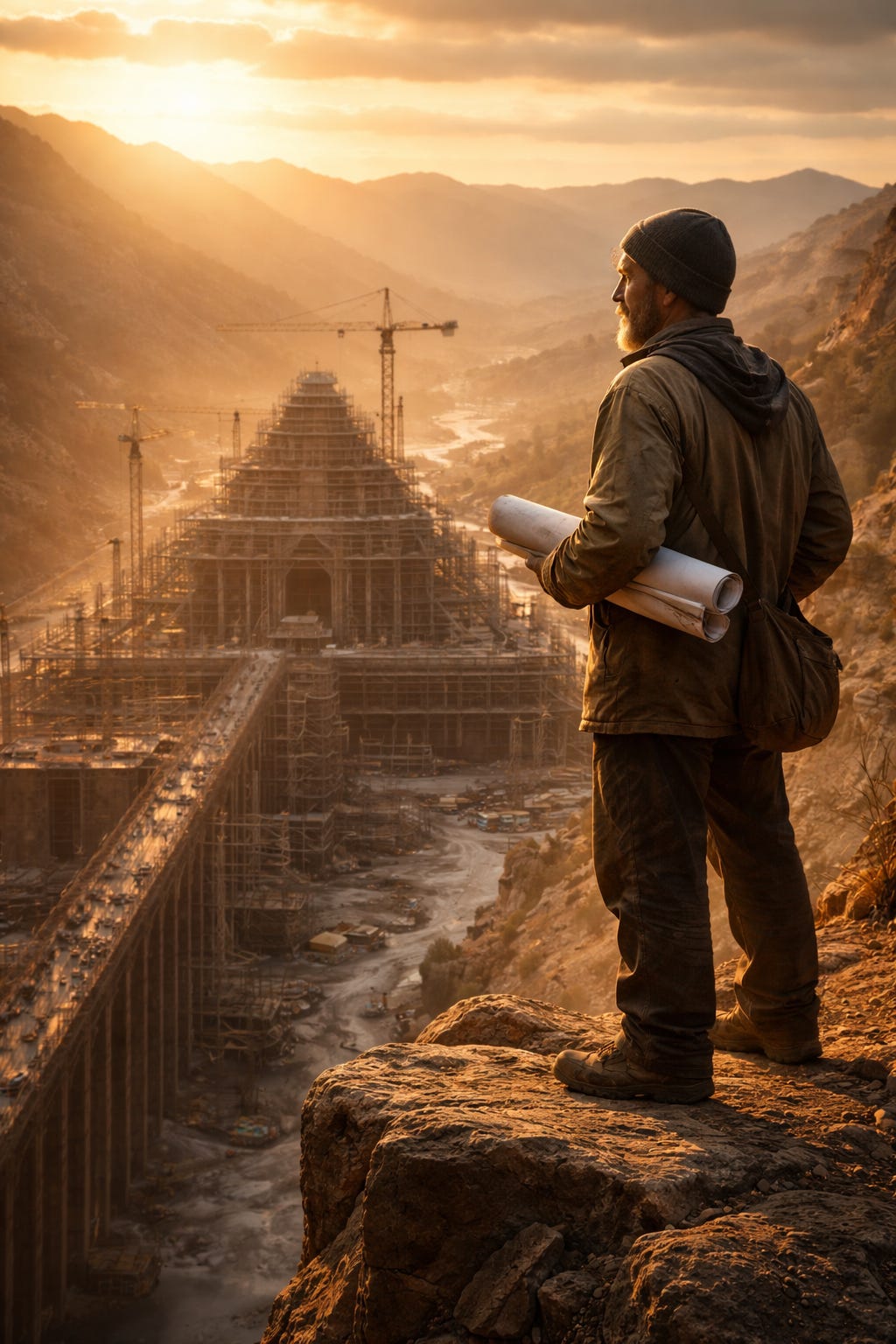
A person’s main occupation will develop his spirit if he is regularly engaged in work that requires overcoming great difficulties. Finding such a project is not so easy, especially for a great master of his craft, an experienced professional who knows his trade well. Any diligent student eventually reaches such a level of skill that no task connected with his field seems especially difficult anymore. The one thing no one can get used to is projects of unusual size and scale. If there is so much work that it is physically impossible to complete it in a short time, then one must continue even when inspiration has vanished and the working mood that first made the author begin the task has dissipated. One has to labor in every state, despite fatigue, and the risk of ruining everything by losing vigilance and making one wrong move grows with every hour, day, and month.
Immersed in a sea of details, the maker begins to wonder whether he was rash to take on something so painstaking, starts looking for ways to simplify the task, and struggles against the temptation to cut corners or even to abandon the unfinished labor altogether.
Another difficulty of large-scale projects lies in the great responsibility attached to every step one takes. Any work contains some element of surprise, but the unexpected things awaiting us at the end of the road are not always pleasant. An experienced person will not be terribly upset on learning that he has labored in vain for two hours because of miscalculations or because his plan failed. Every professional has had to redo work at some point. It is worse when an entire day or even several days has been wasted, and much harder still to come to terms with the loss of one or many months. But what if years are at stake? The larger the task and the longer a person is occupied with it, the more frightening it becomes to botch it. Moreover, giant projects are usually tied to enormous expense: large things consume more materials, and many do not want to risk the result by economizing on quality. That is why the irresistible desire to create something large-scale is often accompanied by the fear of ruining everything.
One may try to plan the work ahead, estimate the time and the cost, make sketches and miniature, simplified models of what should emerge in the end. But this labor too is exhausting and guarantees no success. What is indispensable and central in such a project is the strength that allows one to preserve inner balance equally at the beginning, in the middle, and at the end of the journey.
A student working on his spirit is not obliged to know what the thing he is engaged in is called - life itself will force him to make efforts in the right direction, if he truly wants to bring what he has begun to completion despite changes of mood, fatigue, and fear. Without attaining a certain wholeness, he will not be able to grasp, plan, and think through something that appears boundless to him, to distribute his strength, and to survive the triumph of victory.
Every truly difficult and successfully completed work raises a person to yet another spiritual stage, and this achievement cannot be taken away by anyone.